How to Liquidate an Office in Northern California: A Complete Guide


Office liquidation is the process of removing, appraising, selling, donating, and disposing of all furniture, equipment, and assets from a commercial space — and doing it on a timeline that doesn’t blow your lease or your budget.
Maybe you’re closing a location. Maybe you’re downsizing from three floors to one. Maybe your company went remote and nobody’s sat in those Herman Millers since 2022. Or maybe the economic headwinds finally caught up and the board made a call. Whatever the reason, you’re staring at a building full of stuff that needs to not be there anymore.
This guide covers the full process — from first assessment to final sweep — based on 30 years of doing this across Northern California. Not theory. Not a sales pitch. Just how it actually works.
What Office Liquidation Actually Means (And What It Doesn’t)
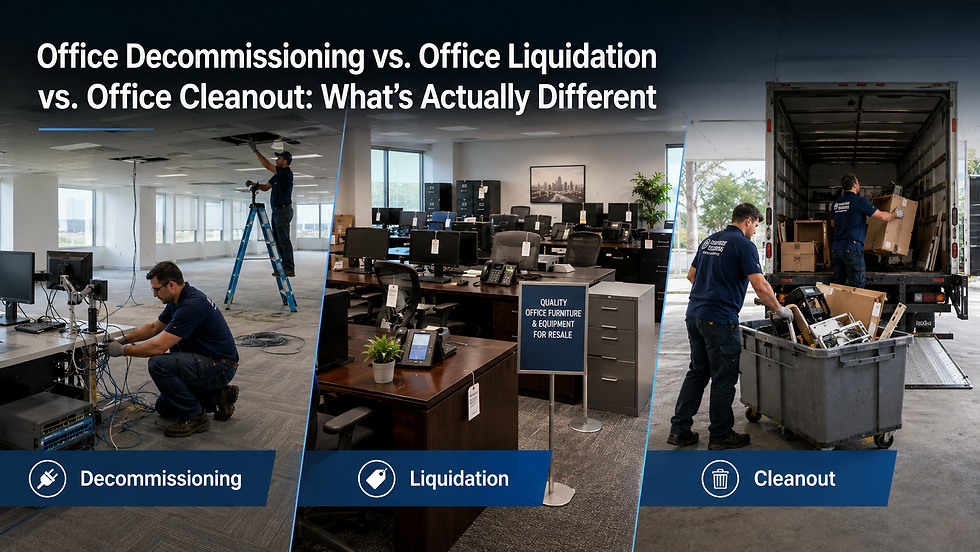
Office liquidation is the systematic removal and disposition of all commercial assets from a workspace. That’s the textbook answer. In practice, it’s a logistics operation that touches procurement, facilities, legal, finance, and sometimes HR — all under a deadline.
What it is not: junk removal. A junk hauler shows up with a truck and throws things away. A liquidation company recovers value first. We appraise what you have, buy what’s worth buying, donate what’s usable, recycle what’s recyclable, and only trash what has no other option. The difference shows up in your bottom line.
Liquidation also isn’t just “moving.” A moving company takes your stuff from Point A to Point B. We make it disappear — responsibly, profitably, and on schedule.
Step 1: Assess What You’re Working With
Before anything moves, you need a full picture of what’s in the space. That means walking every floor, every closet, every server room, and every storage area. The stuff people forget about is usually the stuff that causes problems later.
A professional liquidation company will do a site assessment that catalogs everything: desks, chairs, cubicle systems, conference room setups, server racks, AV equipment, break room appliances, lobby furniture, filing systems, artwork, signage — all of it. The goal isn’t just counting items. It’s categorizing them: what has resale value, what can be donated, what needs certified disposal (like e-waste and data-bearing devices), and what goes to the recycler.
At Norcal, we offer two ways to start: a full on-site walkthrough for larger or complex spaces, or a photo-based assessment where you upload images through our website and we come back with an initial scope and estimate. Either way, no cost and no commitment to get the conversation started.
Pro tip from 30 years of doing this: don’t skip the assessment because you think you know what’s in there. We’ve walked into “small” offices that had three storage rooms full of old equipment nobody remembered existed. Surprises on assessment day are fine. Surprises on moving day are expensive.
Step 2: Understand What Your Stuff Is Actually Worth
Office furniture holds more resale value than most people realize — especially premium brands like Herman Miller, Steelcase, Haworth, Knoll, and Humanscale. A five-year-old Aeron chair in good condition can still fetch a meaningful price on the secondary market. Standing desks, quality task chairs, and solid wood conference tables are in particularly high demand right now.
On the other hand, generic laminate desks, worn fabric chairs, and outdated cubicle systems have limited resale value. That doesn’t mean they’re worthless — many can be donated to nonprofits or recycled — but they won’t offset your costs the same way.
A professional liquidator will appraise everything at fair market value and present a buyout offer. That number gets applied directly against the cost of the liquidation project. In some cases, the asset value covers most or all of the job.
Here’s what most people get wrong: they either assume everything is worthless (and miss thousands in recoverable value) or they assume everything is valuable (and waste weeks trying to sell individual pieces on Craigslist). Neither approach works. Get a professional appraisal, get a real number, and make decisions from there.
Step 3: Build a Timeline Around Your Deadline
Every office liquidation runs on a deadline. Lease expirations, new tenant move-in dates, construction schedules, building sales — there’s almost always a hard date that everything has to be done by. Miss it, and you’re looking at holdover rent, lost deposits, or worse.
Most liquidation projects take between 3 and 14 days of active work, depending on the size and complexity of the space. A small office suite can be cleared in a day. A multi-floor corporate campus with server rooms, medical equipment, or specialized fixtures could take two to three weeks.
But here’s what people don’t account for: the front-end time. Getting a quote, reviewing the scope, signing off on the plan, and scheduling the crew typically adds another 5 to 10 business days before anyone shows up with a dolly. So if your lease ends in 30 days, you don’t have 30 days. You have about 15.
The single biggest mistake in office liquidation is waiting too long to start. The second-biggest is assuming you’ll figure it out as you go. Start the conversation early, even if your timeline feels comfortable. Comfortable timelines have a way of shrinking.
Step 4: Choose the Right Liquidation Partner
Not all liquidation companies are created equal, and the wrong choice can cost you more than the right one saves. Here’s what to look for when vetting a partner:
Full-service capability. Can they handle the entire scope — appraisal, removal, disposal, donation, cleaning, and documentation? Or will you need to hire two or three vendors to cover what one should handle? Every additional vendor adds cost, coordination overhead, and risk.
Local market knowledge. A company that works in Northern California knows the building managers, the disposal facilities, the donation partners, and the permit requirements. They’ve done this in your city before. That matters more than most people think.
Insurance and licensing. This is non-negotiable. Your liquidation partner should be fully licensed, bonded, and insured. Ask for certificates. If they hesitate, walk.
References you can actually call. Not testimonials on a website — real contacts from real projects. A company with 30 years of work behind them should have no trouble producing these.
Transparent pricing. A legitimate liquidator will give you a clear, written quote that accounts for the buyback offset. If the pricing feels vague or the numbers don’t add up, trust your instincts.
Step 5: The Clearout — How the Physical Work Happens
Once the plan is approved and the crew is scheduled, the physical liquidation follows a predictable sequence. Understanding it helps you know what to expect and when.
First, high-value items are identified, tagged, and staged for removal. These go to resale channels, auction, or direct buyer networks. This is the asset recovery phase — the part that puts money back in your pocket.
Next, donatable items are separated and routed to partner nonprofits and charities. This diverts usable furniture from landfills and can generate tax-deductible receipts for your company.
Then the remaining items are broken down for recycling or disposal. Metals, plastics, wood, and electronics each go through their own stream. E-waste gets handled through certified channels that ensure data destruction and environmental compliance.
Finally, the crew does a full sweep of the space: trash removal, surface cleaning, minor repairs like wall patching and paint touch-ups, and a final walkthrough to make sure nothing was missed.
The whole thing is coordinated around your building’s access rules — freight elevators, loading docks, security protocols, quiet hours. A good liquidation crew works around your building’s requirements without needing to be told twice.
Step 6: Broom Sweep and Final Restoration
Getting the furniture out is only half the job. The space still needs to pass your landlord’s final inspection, and most commercial leases have specific requirements for how the space should be returned.
A professional broom sweep goes beyond basic cleaning. It includes complete trash and debris removal, cleaning of all surfaces including floors, walls, and windows, patching nail holes and screw marks, paint touch-ups where needed, fixture removal or replacement, and proper decommissioning of any remaining AV or data infrastructure.
The goal is “make it look like nobody was ever here.” That’s the standard, and it’s what gets your security deposit back.
This is where most DIY efforts and junk removal companies fall short. They get the big stuff out but leave the space looking rough. A landlord doing a final walkthrough notices everything — scuff marks, cable holes, dust lines where furniture used to be. A professional liquidation crew handles all of it because the job isn’t done until the keys are handed back clean.
Step 7: Documentation and Compliance
Office liquidation generates paperwork, and that paperwork matters. Your company, your landlord, your accountant, and potentially your insurance carrier all want documentation showing what happened, where everything went, and that it was done properly.
A complete documentation package includes a detailed asset inventory with photographic records, disposal certificates for e-waste and hazardous materials, donation receipts for tax purposes, certificates of insurance, building compliance records, and a final project completion report.
This isn’t busywork. Disposal certificates prove you didn’t dump electronics in a landfill. Donation receipts give you a legitimate tax deduction. Insurance certificates protect you if anything goes wrong during the project. And the completion report is your proof to the landlord that the space was returned in proper condition.
If your liquidation company doesn’t provide this documentation automatically, that’s a red flag.
The 5 Most Common Mistakes in Office Liquidation
After clearing over a thousand offices across Northern California, we’ve seen the same mistakes come up again and again. Avoid these and you’ll save time, money, and stress.
1. Waiting too long to start. We said it already, but it bears repeating. The number one reason liquidation projects go sideways is that someone waited until two weeks before the lease ended to pick up the phone. Start early. Even a preliminary conversation gives you options you won’t have later.
2. Trying to sell furniture piecemeal. Posting individual desks on Facebook Marketplace sounds smart until you’re three weeks in, you’ve sold four chairs, and the lease deadline is tomorrow. The math almost never works out. A bulk buyout from a professional liquidator is faster, cleaner, and usually nets you more money.
3. Hiring a junk removal company instead of a liquidator. If your office has any furniture with resale value — and most offices do — a junk hauler is the most expensive option. They charge you to throw away things someone would have paid you for. That’s leaving money on the table, literally.
4. Forgetting about the broom sweep. Getting the furniture out and getting the space lease-compliant are two different things. If your plan doesn’t include restoration, you’re going to be scrambling at the end when the landlord rejects the walkthrough.
5. Not reading the lease. Your commercial lease spells out exactly what condition the space needs to be in when you leave. Some require restoration to original condition. Some require specific disposal documentation. Read it before you plan anything.
What Office Liquidation Costs (And How to Offset It)
The cost of office liquidation depends on square footage, volume of items, timeline pressure, disposal requirements, and access logistics. There’s no single number that applies to every project.
But the number that actually matters is the net cost: total project cost minus the buyback value of your assets. In many cases, the furniture and equipment recovery covers a significant portion of the bill. Sometimes all of it.
Factors that increase cost: tight timelines requiring overtime or weekend crews, hazardous materials or specialized disposal needs, difficult building access (no freight elevator, narrow hallways, upper floors), and large volumes of low-value items that require disposal rather than resale.
Factors that decrease cost: high-value furniture brands in good condition, reasonable timelines that allow for efficient scheduling, clean and organized spaces that minimize sorting time, and flexibility on start dates.
The only way to know your real number is to get a quote. At Norcal, quotes are free, come with an asset appraisal, and carry no obligation. Upload photos through our website or call 916-212-6695.
Why Northern California Is a Unique Market
Office liquidation in Northern California has its own dynamics that don’t apply everywhere. Understanding them can save you money and headaches.
The tech cycle drives demand. When startups scale, they buy premium furniture. When they downsize — or shut down — that furniture floods the secondary market. This affects appraisal values and timing. Liquidating during a wave of tech layoffs means more competition for buyers. Liquidating during a growth period means higher recovery values. Timing matters.
Building requirements vary wildly. San Francisco high-rises have different access rules, union requirements, and inspection standards than a Sacramento office park. A liquidation company that works across Northern California knows these differences cold. A national company flying in a crew from out of state does not.
Sustainability regulations are stricter here. California’s e-waste disposal laws and environmental compliance standards are among the toughest in the country. Certified disposal isn’t optional — it’s legally required. Working with a local company that already has established recycling and donation partnerships makes compliance automatic instead of an afterthought.
The Bay Area, Silicon Valley, Sacramento, and the East Bay each have their own commercial real estate rhythms. What’s happening in Palo Alto’s office market isn’t the same as what’s happening in Walnut Creek. Local knowledge is a real advantage.
The Bottom Line
Office liquidation doesn’t have to be complicated. The process is straightforward when you have the right partner: assess, appraise, plan, clear, restore, document. Six steps. One team. Done.
The hard part is finding a company that actually handles all of it — not just the easy stuff, not just the removal, but the appraisal, the compliance, the broom sweep, and the documentation. A company that shows up when they say they will and finishes when they said they would.
Norcal Office Liquidators has been doing this across Northern California for over 30 years. We’ve cleared more than a thousand offices, from two-person startups to 20-floor headquarters. If you’re staring at a space that needs to be empty, we’ll get it done.
Upload photos for a free quote at norcalofficeliquidators.com or call Bryan @ 916-212-6695.


Comments