What to Do With Office Furniture When Your Lease Is Expiring


Your lease is ending and the office is still full of furniture. This is one of the most common — and most stressful — situations in commercial real estate, and the window for handling it is shorter than most people think.
Every day past your lease end date can mean holdover charges, lost security deposits, and an increasingly frustrated landlord. The good news: if you act now, this is a solvable problem. Here’s exactly what to do, step by step.
First: Stop Trying to Sell It Yourself
The instinct is understandable. You’ve got a floor full of desks and chairs that cost real money, so posting it all on Craigslist or Facebook Marketplace seems like the smart move. It’s not — at least not at scale.
Selling individual pieces takes weeks of listing, messaging, scheduling pickups, dealing with no-shows, and hauling what doesn’t sell. When you’re on a lease deadline, you don’t have that kind of time. And the money you’d make piecemeal is almost always less than what a professional liquidator will offer as a bulk buyout.
We’ve walked into offices where the facilities manager spent six weeks selling chairs one at a time on Marketplace — and still had 80% of the furniture left on move-out day. Save yourself the headache. The math doesn’t work, and neither does the timeline.
Know What Your Furniture Is Actually Worth
Before you assume it’s all worthless — or all valuable — get an appraisal. Office furniture value depends on brand, condition, age, and current market demand.
Premium brands like Herman Miller, Steelcase, and Haworth hold value well. Standing desks and quality task chairs continue to move quickly on the secondary market, especially from recognized brands. Generic laminate desks and worn-out chairs? Less so. But you won’t know until someone who knows the market takes a look.
A professional liquidator will appraise everything and give you a buyout number. That number offsets the cost of clearing the space. In 30 years, we’ve seen offices sitting on five figures of resale value without knowing it — and we’ve seen offices where the honest answer was close to zero. Either way, you want that number before you make any decisions.
Understand Your Lease Obligations
Most commercial leases require the space to be returned in a specific condition — typically broom-swept, free of all tenant property, and with any modifications restored. Read your lease carefully. Common requirements include removal of all furniture and personal property, removal of any installed fixtures or equipment (sometimes), patching and painting if you modified walls, proper disposal of e-waste and hazardous materials, and carpet cleaning or replacement.
We’ve seen six-figure security deposits disappear because a tenant didn’t read the restoration clause until the walkthrough. One missing line about removing cabling above the drop ceiling, one overlooked requirement to restore a wall that got knocked out for an open floor plan — that’s all it takes. Know what’s expected so there are no surprises at the final walkthrough.
Calculate How Much Time You Actually Have
Be honest about your timeline. If your lease ends in 60 days, you have time to plan. If it ends in 14 days, you need to move now. If it ends next week, you need emergency service.
Most professional liquidation projects take 3 to 14 days from approval to cleared space. Smaller offices can be done faster. But this doesn’t include the time to get a quote, approve the scope, and schedule the crew — which typically adds another few days on the front end.
The biggest mistake tenants make is waiting. The second-biggest mistake is underestimating how long the full process takes. After 30 years of doing this, we can tell you: the call we get most often starts with “I probably should have called you a month ago.” Start the conversation as soon as you know you’re leaving.
Your Options, Ranked by Practicality
Here’s the honest breakdown of what you can do with that furniture, from best option to last resort.
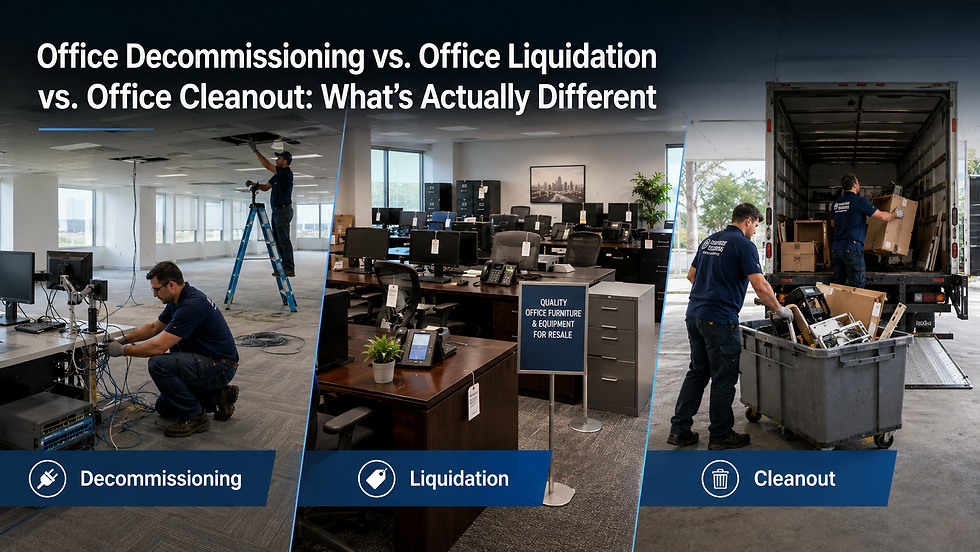
Option 1: Hire a professional liquidation company. They appraise everything, make a buyout offer, remove all items, handle disposal and donation, and leave the space broom-swept and inspection-ready. One vendor, one timeline, one invoice. This is the fastest and most cost-effective path for most businesses.
Option 2: Donate everything. If the furniture is in usable condition, local nonprofits may take it. The challenge is logistics — most charities don’t do large-scale commercial pickups on your schedule, and you’re still responsible for whatever they don’t take. You do get a tax deduction, but you still need someone to handle the rest.
Option 3: Hire a junk removal company. They’ll haul it all away, but they won’t buy anything, won’t appraise anything, and won’t leave the space in lease-compliant condition. You’re paying full removal cost with zero offset. This should be a last resort.
Option 4: Do it yourself. Possible for very small offices. Impractical for anything larger. You’ll need trucks, labor, disposal facilities, and a plan for what goes where. Most people who start down this road call a professional halfway through.
What to Do If You’re Already Behind
If your lease ends soon and you haven’t started, don’t panic — but do pick up the phone. Emergency liquidation services exist for exactly this situation.
Norcal Office Liquidators deploys crews within 24–48 hours for time-critical projects. We’ve cleared offices on weekend notice more times than we can count. We’ve had crews working at midnight because the new tenant’s build-out started Monday morning. It costs more than a planned project, but it costs a lot less than holdover rent and a lost security deposit.
Call 916-212-6695 directly for emergency requests. The faster we know about it, the faster it’s handled.
Don’t Forget the Broom Sweep
Getting the furniture out is only part of the job. The space still needs to pass your landlord’s final inspection. That means trash removal, surface cleaning, wall patching, paint touch-ups, and proper disposal of any remaining e-waste or equipment.
This is where DIY efforts and junk removal companies typically fall short. They get the big stuff out but leave the space looking like it was abandoned in a hurry. A professional liquidation company handles the full scope — from first box to final sweep — so you hand back a clean space and get your deposit back.
The Takeaway
A lease deadline with a full office isn’t a crisis — it’s a Tuesday for a professional liquidation company. The key is starting early, understanding what your furniture is worth, and working with someone who handles the complete process so nothing falls through the cracks.
Don’t wait until it becomes an emergency. But if it already is one, we’ve got you.
Lease ending soon? Upload photos for a free quote at norcalofficeliquidators.com or call 916-212-6695.


Comments