Where Does a Dead Office Go?

What actually happens to a Northern California office after the lights go out — and why the conversion boom starts with a clearout.

Every apartment that used to be an office started the same way: somebody had to empty the building first. Before a single wall comes down, before a lease gets signed, before a developer ever walks a prospective tenant through a model unit — the floor has to be cleared, the assets have to leave, and the space has to be decommissioned. That part almost never makes the news. It’s also the part we do.
If you’ve driven through downtown lately and wondered what happens to all that quiet square footage, you’re asking the right question. The short answer: a dead office doesn’t just sit there. It gets emptied, sorted, and sent in three directions at once. Here’s where it actually goes.
The great emptying is real — and Northern California is in the thick of it
The numbers behind office conversions stopped being a curiosity and became a movement. According to RentCafe, office-to-apartment conversions reached roughly 90,300 units across the U.S. at the start of 2026 — a 28% jump over the prior year. And California leads every state in the country, with about 135 conversion projects in the pipeline, per industry tracker Propmodo. One of them is hometown news: San Jose’s historic Bank of Italy Tower has begun its second life as housing.
That wave is being fed by office space that simply isn’t coming back the way it left. As of the first quarter of 2026, Cushman & Wakefield reported downtown vacancy rates
still parked above 30% across the Bay Area’s biggest cities — 30.8% in downtown San Jose, 31.1% in San Francisco, and a striking 37.8% in downtown Oakland. When a third of a downtown is empty, owners stop waiting for tenants and start rethinking the building itself.

Sacramento is the exception that proves the point
Here’s the wrinkle that makes the regional story interesting: Sacramento didn’t hollow out the way the coastal markets did. Colliers pegged the region’s office vacancy at about 21.3% in early 2026 and called the market effectively bottomed, while Kidder Mathews noted that downtown Sacramento has held vacancy below 10% — outperforming nearly every other West Coast downtown. A heavy base of state-government tenants kept the core occupied even as private offices thinned out.
But “better than the Bay Area” isn’t the same as “back to normal.” Colliers expects office conversions and redevelopment to keep climbing here too, especially for older, functionally obsolete buildings that won’t win the flight-to-quality competition. Translation: whether a building is getting converted, consolidated, or quietly handed back to the landlord, somebody has to empty it first. That’s true at 38% vacancy in Oakland and at 9% in downtown Sacramento. The work doesn’t care about the rate — it cares about the move-out date.

The invisible first chapter
Every conversion, sale, or downsize has a chapter nobody photographs: the day before the architects show up. We’ve walked into floors where the coffee was still in the machine and the whiteboard still had a Q1 plan on it. The renderings come later. The empty building comes first — and getting it empty is its own discipline.
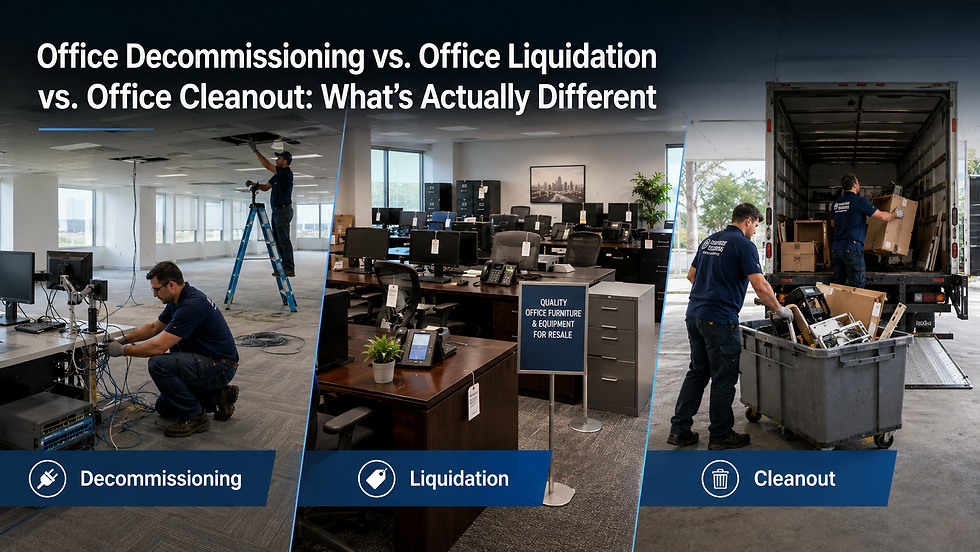
We break that work into three jobs that often get blurred into one word. We covered the distinctions in detail in an earlier Clearout post, but the short version is the cleanest way to understand where a dead office goes:
Decommissioning is about the space — returning the floor to the condition the landlord, lender, or next use requires.
Liquidation is about the assets — what gets resold into the secondary market, redistributed, donated, or recycled.
Cleanout is about the volume — the sheer cubic footage that has to physically leave the building, responsibly.

What we actually see walking in
After enough years of this, an empty office reads like a time capsule. We’ve cleared floors that were frozen mid-2020 — calendars still flipped to March, a fridge nobody had the heart to open, a row of monitors waiting for people who never came back. We’ve hauled out conference tables that seated twenty in buildings that now plan to seat zero. A 30-year-old company doesn’t encounter a “typical” office; it encounters every version of the American workplace, abandoned in place.
None of that is sad once you know where it’s headed. A dead office is just raw material that hasn’t been sorted yet.

Where the office actually goes
The assets go back into circulation
Desks, chairs, cubicle systems, filing, AV, and equipment rarely belong in a landfill. The good stuff re-enters the secondary market, gets redistributed to organizations that need it, or is donated. What can’t be reused gets routed to recycling streams instead of the dumpster. The guiding goal is simple: keep usable assets in use and keep everything else out of the waste stream wherever it’s feasible.
The space goes back to spec
Decommissioning is the part landlords and lenders actually care about. Demising walls, cabling, signage, anchored fixtures, and anything tied to the previous tenant come out so the floor can be handed back — or handed off to the team that will turn it into apartments. A clean decommission is what lets the next chapter start on schedule instead of stalling in a dispute over what was supposed to be removed.
The volume goes out the right way
The unglamorous truth of a clearout is logistics: elevators, dock times, building hours, and a plan for sorting what gets reused, recycled, or disposed of. Done well, an entire floor leaves a building without the property manager getting a single angry email. Done badly, it’s the thing everyone remembers about the move.

Why this matters right now
The conversion boom and the consolidation wave look like opposite stories — one building filling up with residents, another company shedding three floors it no longer needs — but they share a first step. Before the developer, before the broker, before the apartment listing, there’s a building that needs to be empty. In a market where Northern California leads the nation in office conversions, that first step is getting busier, not quieter.
So the next time you read that a downtown tower is becoming housing, picture the chapter that didn’t make the article: the week the floors got cleared. That’s where a dead office goes. And that’s the call that comes first.
Frequently asked questions
What happens to office furniture and equipment during a liquidation?
During an office liquidation, usable furniture and equipment are resold into the secondary market, redistributed, or donated, while items that can’t be reused are routed to recycling streams. The aim is to keep functional assets in use and divert as much as possible from the landfill.
What’s the difference between office decommissioning and an office cleanout?
Office decommissioning restores a space to the condition a landlord or lender requires by removing tenant improvements, cabling, and fixtures, while an office cleanout focuses on physically removing the volume of contents from the building. Most full move-outs involve both.
Do office buildings need to be cleared before being converted to housing?
Yes. Before an office building can be converted to residential use, every loose asset and tenant-installed fixture has to be removed and the space decommissioned, which is the first physical step in any office-to-residential conversion.
Planning a move, a downsize, or a conversion in Northern California?
Norcal Office Liquidators handles the part that comes first — the clearout, the liquidation, and the decommission that gets a building ready for whatever’s next.
Call 916-212-6695 • norcalofficeliquidators.com
Comments