Office Decommissioning vs. Office Liquidation vs. Office Cleanout: What's Actually Different

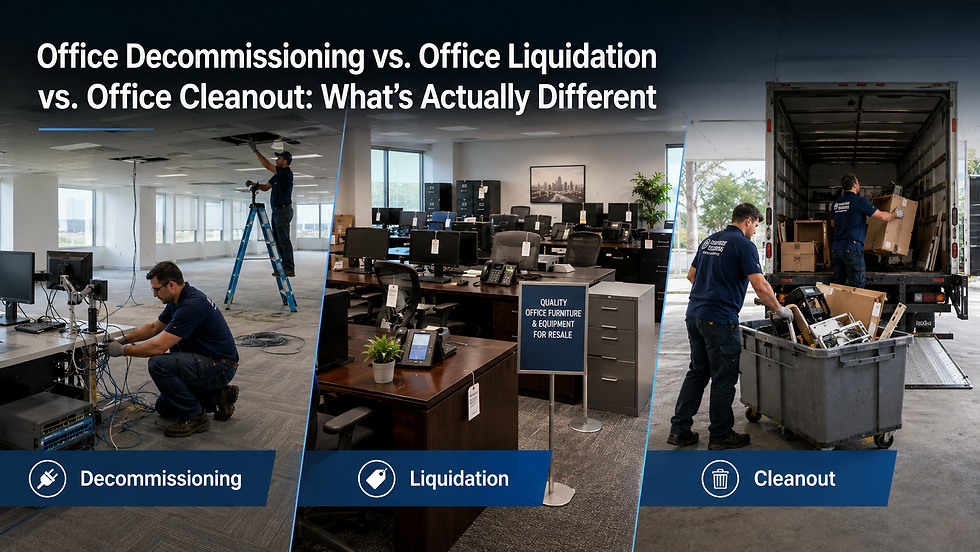
Office decommissioning, office liquidation, and office cleanout are three different services that get used as if they're the same thing — and the confusion costs real money. Choosing the wrong one for your situation means either paying for work you didn't need, or worse, signing up for a scope that doesn't actually solve the problem you're trying to solve.
After thirty years and more than a thousand offices, we've learned that most people pick up the phone with the wrong word in their mouth. They ask for a cleanout when they need a decommissioning. They ask for a liquidation when they need both. Sometimes the person on the other end of the phone doesn't correct them, and the job goes sideways from there.
This post is the short version of the conversation we wish more people had at the beginning. Three definitions, the differences that matter, and a quick way to figure out which one (or which combination) you actually need.
The shortest possible answer: decommissioning is about the space. Liquidation is about the assets. Cleanout is about the volume. Everything below is the longer version of that.
Office Decommissioning
The definition
Office decommissioning is the process of returning a leased office space to the condition required by the lease at the end of a tenancy. It's defined by the destination — a delivered space that meets contractual obligations by a specific date — not by any particular set of activities.
What the work actually includes varies by lease. A simple decommissioning might mean removing furniture, pulling cabling, and a final sweep. A complex one might include demolishing tenant improvements, patching walls, refinishing floors, removing branded built-ins, and a deep clean to building-standard. The lease defines the scope. The deadline defines the timeline. The work follows from both.
The defining feature
Decommissioning is tied to a lease. That's what makes it different from the other two. If there's no lease deadline driving the work — no surrender clause to satisfy, no walkthrough on the calendar — what you're doing is something else.
When you need it
You're not renewing. You're consolidating offices and giving back one of them. You've subleased the space and the sublease is ending. Your company is closing the office entirely. In all of these cases, there's a date on the lease and a condition you're required to deliver. That's decommissioning.
What people get wrong
The most common mistake is underestimating the scope. People focus on "getting the furniture out" and forget that the lease may require removing cabling above the ceiling, patching holes from anchored shelving, repainting accent walls, or returning tenant-installed kitchens to base condition. The walkthrough surfaces all of it, and the costs land on the deposit.
We've seen tenants spend a weekend hauling furniture out, congratulate themselves, and then lose tens of thousands of dollars in deposit because nobody touched the cabling, the wall anchors, or the back room with the dead IT equipment.
Office Liquidation
The definition
Office liquidation is the process of converting the assets in an office into cash, credit, or offset value. It's defined by what's worth something — chairs, desks, conference room equipment, AV gear, filing cabinets, anything with a secondary market — and what to do with it.
A liquidation identifies the assets, separates them from what isn't worth recovering, and either buys them outright, brokers them, or applies their value as a credit against the cost of the broader project. The end state is a space with the valuable items removed and accounted for, not necessarily an empty space.
The defining feature
Liquidation is about value, not volume. A liquidation can leave behind a lot of stuff that has no resale value, because that's not what liquidation is for. It's the asset side of the equation.
When you need it
You're moving out and you want to recover something on the furniture and equipment instead of paying to throw it away. You're downsizing your office in place — keeping the lease, just using less of it — and you have surplus furniture to convert. You're refreshing a space and replacing older furniture with new, and you want to offset some of the cost. You've inherited an office full of assets from an acquisition or a closed location and need to know what they're worth.
Notably, liquidation doesn't require a lease end. It's not tied to a deadline. It can happen anytime there are assets in an office that someone wants to convert.
What people get wrong
The most common mistake is assuming everything in the office has value. It doesn't. The second most common mistake is assuming nothing in the office has value. It usually does — just not always the things people expect. A real liquidation conversation starts with an honest look at what's there and what the market will pay for it, not a guess in either direction.
Office Cleanout
The definition
Office cleanout is the removal of everything inside an office. It's defined by volume — getting the contents out — without a built-in commitment to lease compliance, asset recovery, or restoration of the space afterward.
A cleanout might use the same trucks and the same crews as a decommissioning or a liquidation, but the scope is narrower. The promise is removal. What happens to the items after they leave the building, and what condition the space is in after they're gone, are separate questions.
The defining feature
Cleanout is about volume in motion. It answers "how do I get all of this out" and stops there. It doesn't answer "is the space ready for the landlord" or "is there anything here worth recovering."
When you need it
You've already handled the lease side. The walkthrough is done or doesn't apply. You've already separated out anything valuable. What's left is a volume problem, and you need it gone. Cleanout is the right scope.
Cleanout is also what some companies sell when they don't actually do decommissioning or liquidation. A junk hauler with a truck can do a cleanout. That doesn't make them a decommissioning company.
What people get wrong
The most common mistake is assuming a cleanout covers the lease obligation. It usually doesn't. The contents leave, but the wall anchors stay, the cabling above the ceiling stays, the carpet damage stays, the back-room electronics may or may not have been disposed of properly. None of that is the cleanout company's problem unless they explicitly took it on.
The other common mistake is asking for a cleanout when you actually wanted a liquidation. Once it's on the truck headed to a transfer station, the resale value is gone. We've had calls from people watching their old furniture drive away who wanted to know if we could intercept it. Sometimes we can. Usually we can't.
The Differences That Matter
Three places where the distinctions show up in real decisions:
Who you owe at the end
Decommissioning has a customer on both sides — the tenant who hires the work, and the landlord who has to accept the space at the end. The job isn't done until the landlord signs off. Liquidation has buyers — secondary market customers who want the assets — and the job is done when the assets are converted. Cleanout has neither of those downstream obligations. The job is done when the truck pulls away.
This is why decommissioning costs more than cleanout for the same square footage. You're not paying for the same scope of work.
What the price is paying for
A decommissioning quote should include the labor to remove items, the disposal or recycling fees for items with no value, the cost of any restoration work required by the lease, and the cost of the final cleaning. It may also include a credit for items that have resale value, which is where the liquidation piece often gets folded in.
A liquidation quote is structured differently — it's typically an offer for assets, sometimes paired with a service fee for the work to remove them. A pure asset purchase can result in the customer being paid, not paying.
A cleanout quote is the simplest. It's labor and disposal, priced by volume. Nothing more is promised.
Reading a quote without knowing which of the three it is leads to bad comparisons. A $4,000 cleanout quote and a $9,000 decommissioning quote aren't competing on the same scope, even if they're for the same office. They're answering different questions.
What happens if you pick wrong
Pick a cleanout when you needed a decommissioning, and you lose your deposit. The space wasn't returned to lease condition, and the landlord catches it on the walkthrough.
Pick a cleanout when you needed a liquidation, and you pay to throw away things you could have sold. The math can be brutal — paying $3,000 to dispose of $15,000 worth of furniture is a real outcome we've seen more than once.
Pick a decommissioning when all you really needed was a cleanout, and you've paid for restoration work nobody required. Less common, but it happens when companies don't read their lease carefully and assume the obligations are heavier than they are.
How to Figure Out Which One You Actually Need
Three questions, in order:
Is there a lease deadline driving this? If yes, decommissioning is in scope. If the office is leased and you're not renewing, you have lease obligations whether or not you've read them yet.
Is there anything in the office worth something? If yes, liquidation is in scope. This is true whether or not there's also a lease deadline. Even an office in the middle of a long lease can have liquidation needs if it's downsizing or refreshing.
Is the only remaining problem volume? If lease obligations are already handled and asset value has already been addressed, what's left is a cleanout. This is rarer than people think — most jobs are actually combinations of the first two.
Most real jobs are decommissioning with a liquidation component built in. The lease end drives the deadline, and along the way, the assets that have value get pulled out and converted, offsetting the cost of the broader project. That combination is what most people are actually asking for when they call, even when they pick up the phone and ask for a cleanout.
Why the Vocabulary Matters
Even if you're not facing a lease end this year, knowing which word to use changes how you shop, how you compare quotes, and how you talk to your CFO about the cost of a future move.
It also changes who you call. Decommissioning is a specialist service — it requires understanding lease language, restoration standards, building requirements, and the secondary market all at once. Liquidation is also a specialist service, with its own set of relationships and market knowledge. Cleanout is the broadest category, and the one with the most companies competing in it. They're not the same companies, even when the trucks look similar from the curb.
If you're getting quotes, ask each company which of the three they're quoting on. The answer will tell you more about the company than the price will.
Not sure which one you need?
Send us photos of the space from your phone and we'll come back with a quote — usually within a business day, no site visit required. We'll also tell you which of the three scopes actually fits your situation, even if the answer doesn't match the word you used when you called. Reach Norcal at 916-212-6695 or visit norcalofficeliquidators.com.
From first box to final sweep, that's the work.



Comments